
Building a Legal Ops Function in 2026: Mandate, Metrics, Maturity, and Tooling
Legal ops runs an in-house legal team like a business, covering process, technology, and metrics. The CLOC Core 12 and a reactive-to-leading maturity path guide it. Building it means a clear mandate, baseline metrics, core tooling like CLM, and improving in stages.

From Firefighting to Function
Most in-house legal teams start the same way. A handful of lawyers handle everything, contracts pile up, requests arrive from every direction, and the team spends its days reacting. As the business grows, that model quietly breaks. Contract volumes rise faster than headcount, turnaround slows, and the legal team becomes a bottleneck rather than an enabler.
Legal operations is the answer to that pattern. It is the discipline of running the legal team like a business, so that people, process, technology, and data work together and lawyers are freed to focus on actual legal judgment. In 2026, with higher contract volumes, tighter budgets, and rapid technology change, legal ops has moved from a luxury for large enterprises to a practical necessity for growing organizations.
Why Legal Ops Matters in 2026
1. Legal is being asked to do more with less
Contract volumes keep rising while headcount does not, and legal teams feel the strain. Legal ops exists to close that gap, by designing scalable processes and using technology so the team can handle more without simply adding people.
2. The business wants visibility, not black boxes
Finance and leadership increasingly want to see legal's numbers: how long contracts take, where spend goes, and where risk sits. Legal ops brings the metrics and reporting that turn the legal team from an opaque cost center into a measurable business partner.
3. Technology and AI are reshaping the work
Routine drafting, review, and analysis are increasingly automated, and the teams that benefit are the ones with the operational structure to adopt and govern these tools well. Legal ops owns that adoption, including platform consolidation and sensible AI use.
4. A recognized framework exists to build against
Legal ops is not something you have to invent from scratch. The Corporate Legal Operations Consortium, known as CLOC, defines a set of core competencies and a maturity path that give any team a map for where to start and where to grow.
The Building Blocks: The CLOC Core 12
CLOC's Core 12 competencies describe the functional areas a mature legal ops function covers. In practical terms they include strategic planning, financial management, firm and vendor management, technology, business intelligence and metrics, information governance, knowledge management, project and process management, service delivery and design, organizational design and internal resources, and training and development. No team masters all twelve at once. The value of the framework is that it lets you see the full picture and choose where to focus first.
The Maturity Path: Reactive to Leading
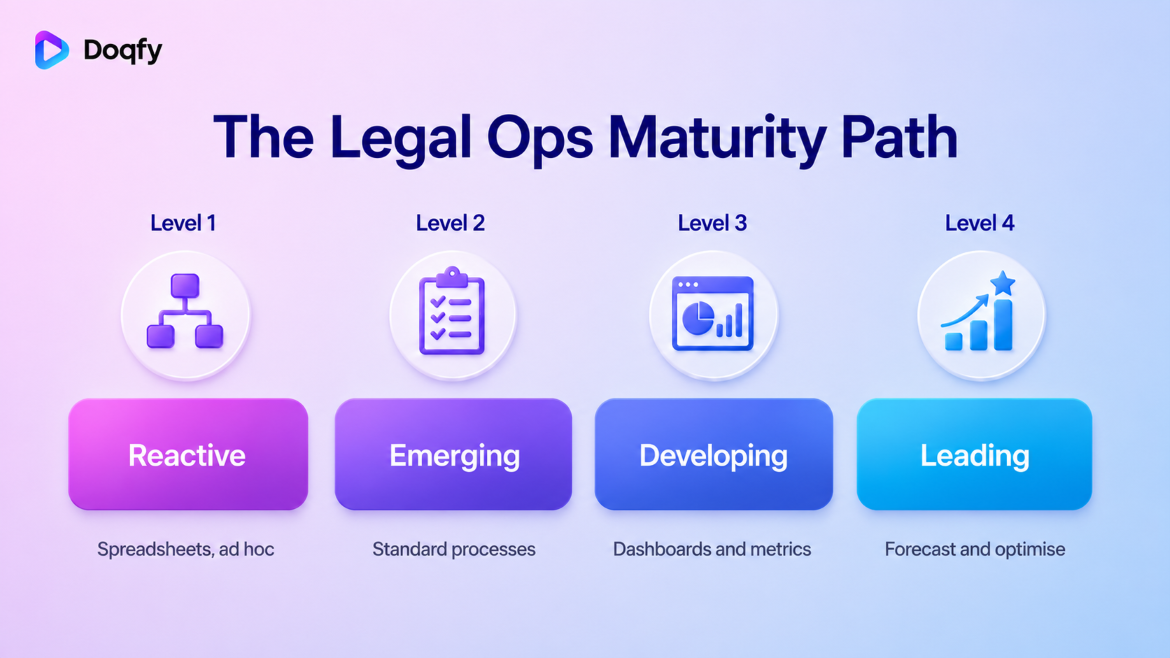
Legal ops does not appear overnight, and maturity models capture that progression. A common way to describe it runs from reactive, where the team tracks matters and data on spreadsheets and responds to requests as they come, through emerging and developing stages, to a leading state where the team uses dashboards and analytics to forecast and optimize. Understanding which stage you are in matters more than aspiring to the top, because it tells you the next practical step rather than an unreachable ideal.
How to Build a Legal Ops Function
1. Define the mandate and the problems to solve
Start with the specific pain: slow contract turnaround, no visibility into spend, inconsistent processes. A clear mandate, agreed with the general counsel and the business, is what gives legal ops direction and authority.
2. Capture baseline metrics
You cannot improve what you do not measure. Establish a baseline for a few meaningful metrics such as contract turnaround time, matter volume, outside-counsel spend, and manual hours per request, so progress is provable.
3. Pick high-impact quick wins
Early credibility comes from visible improvement. Standardizing templates, streamlining intake, or cutting contract cycle time in one function builds momentum before broader change.
4. Choose core tooling
Technology is foundational to legal ops maturity. Contract lifecycle management is often the anchor system, alongside matter and spend management and knowledge management, because contracts are where much of the legal team's volume and value concentrate.
5. Improve in stages
Work through the competencies in sequence, aligned to your maturity stage, rather than attempting everything at once. Steady, embedded improvement outlasts a big-bang programme.
Guardrails for Building Legal Ops in 2026
- Anchor to the business, not just efficiency. The goal is to turn legal into a strategic partner, so align legal ops goals with business outcomes and stakeholder needs.
- Let metrics drive decisions. KPI-driven reporting is a defining feature of high-performing teams, so build measurement in from the start.
- Adopt technology deliberately. Platform consolidation and AI can help, but they need governance and the right implementation to deliver value rather than noise.
- Right-size the model. Frameworks describe well-resourced teams, so adapt the competencies to your size and stage instead of copying a large enterprise wholesale.
Conclusion
Summing up, a legal ops function is what lets a legal team scale without buckling. It brings a mandate, metrics, a maturity path, and the tooling to match, so lawyers spend their time on legal work while the operational backbone keeps the department efficient, visible, and aligned to the business.
The teams that build this well start where they are: a clear mandate, a metrics baseline, a few quick wins, and core systems such as contract lifecycle management, improving in stages rather than chasing full maturity overnight. In 2026, that operational foundation is what separates a legal team that enables growth from one that slows it down.
Explore how contract lifecycle management anchors a modern legal ops function with Doqfy today!
Sources and References
- CLOC Core 12, framework for evaluating legal operations maturity (Corporate Legal Operations Consortium): https://cloc.org/cloc-core-12/
- What is legal ops (Corporate Legal Operations Consortium): https://cloc.org/what-is-legal-ops/
- Legal operations 101: core competencies and role evolution (Streamline): https://www.streamline.ai/article/a-deep-dive-into-legal-operations
- Guide to legal operations in 2026: competencies, trends, and tools (Juro): https://juro.com/learn/legal-operations
- What is legal operations, CLOC Core 12 and maturity levels (Questel): https://www.questel.com/resourcehub/what-is-legal-operations-legal-ops/
- Legal operations in 2026: efficiency, metrics, and maturity (HyperStart): https://www.hyperstart.com/blog/legal-operations/