
Digital KYC and KYB for Vendor and Customer Onboarding: Building Compliant, Audit-Ready Workflows in 2026
KYC verifies individuals; KYB verifies businesses and their beneficial owners. In India this onboarding gate is digital and consent-based, governed by the RBI KYC Master Direction, PMLA, and DPDP. The strongest workflows link verification, consent, and signing into one audit-ready trail.

The Onboarding Decision That Shapes Every Contract
Every customer relationship and every vendor relationship begins with the same question - Is this person or business real, and can we prove it later?
That question is answered by KYC and KYB. KYC, or Know Your Customer, verifies that an individual is who they claim to be. KYB, or Know Your Business, verifies that a legal entity genuinely exists, that the person signing has authority to act for it, and that you know who ultimately owns or controls it. In 2026, both are digital, both are consent-based, and both sit directly in front of the contract.
When verification is treated as a quick formality, problems surface later, usually at the worst moment: a disputed signature, an onboarding that cannot be evidenced, a vendor whose ownership was never checked. When verification is treated as part of the onboarding workflow, it becomes the foundation that makes the contract defensible.
Why KYC and KYB Belong in Your Onboarding Workflow in 2026
1. Verification is a legal gate, not a formality
In India, KYC obligations for regulated entities flow from the Prevention of Money Laundering Act, 2002 and its rules, operationalized through the Reserve Bank of India Master Direction on Know Your Customer. The purpose is to keep the financial system from being used for money laundering or other illicit activity. For businesses beyond the regulated financial sector, the same logic applies commercially: onboarding an unverified counterparty is onboarding unmeasured risk.
2. Verification has gone digital and consent-based
The RBI permits the Video based Customer Identification Process, known as V-CIP, as a consent-based alternative for establishing a customer's identity, treated on par with face-to-face identification. Digital KYC, Aadhaar-based e-KYC, and offline verification of officially valid documents give teams fast, remote ways to verify identity. The trade-off is that these methods carry specific requirements around consent, security, liveness checks, and record storage in India.
3. Business onboarding means knowing who controls the entity
KYB is more involved than KYC because a company can hide behind layers of ownership. Indian rules now require identification of the beneficial owner, and the ownership threshold under the money laundering rules was reduced from twenty-five percent to ten percent, broadening the set of controlling individuals who must be identified. Verifying a business therefore means checking its registration, its authorized signatories, and the natural persons who ultimately own or control it.
4. Verified identity has to connect to the contract
A verification that lives in a separate system from the agreement leaves a gap. If the identity check, the consent, and the signed contract are not linked, a business can prove a person was verified, or that a contract exists, but not that the verified person is the one who signed under the recorded terms. Closing that gap is what turns onboarding from a series of steps into a defensible record.
Where KYC and KYB Touch the Onboarding Lifecycle
- Customer onboarding in BFSI, lending, and insurance. This is the most heavily regulated path, where KYC, consent capture, and execution are inspected closely and must produce a clean evidence trail.
- Vendor and supplier onboarding. Procurement teams increasingly need KYB on suppliers, including registration validity and beneficial ownership, before contracts and data-sharing begin. This is also where onboarding meets third-party risk.
- Partner and channel onboarding. Distributors, agents, and resellers act on your behalf, so verifying the entity and its signatories protects you from acting on an unverified relationship.
- High-volume platform onboarding. With thousands of customers or businesses onboarded each month, manual checks cannot scale, and verification has to be automated, consistent, and recorded by default.
How to Build Compliant, Audit-Ready KYC and KYB Onboarding
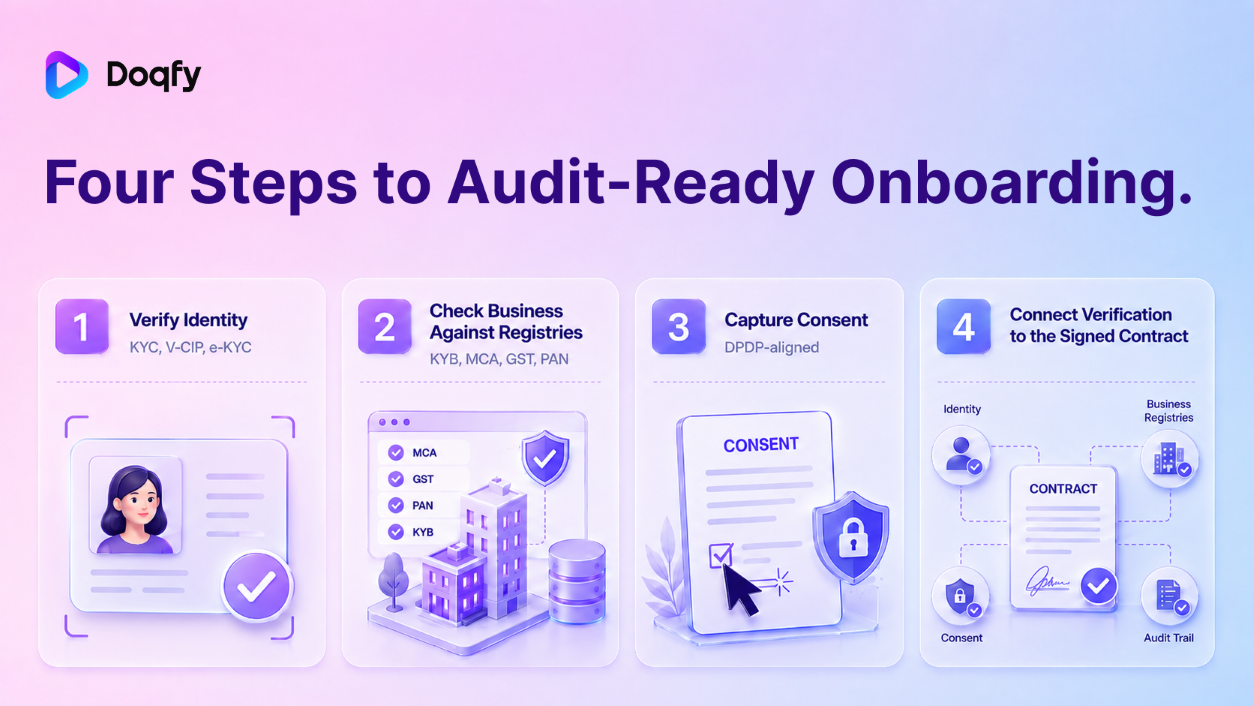
1. Standardize the verification checklist by entity type
Define exactly what is required for an individual, a company, a partnership, and a trust. Companies typically need incorporation and registration details, authorized-signatory proof, and beneficial-owner identification; individuals need identity and address verification. A standard checklist prevents teams from improvising and missing a step.
2. Use digital, consent-based verification
Adopt V-CIP, Aadhaar-based e-KYC, and document verification with explicit, recorded consent. Capture the consent, the method used, and the result, so the basis of verification is provable later.
3. Verify businesses against authoritative registries
For KYB, validate entity details against official sources rather than relying on uploaded documents alone. Company registration and director details can be checked against the Ministry of Corporate Affairs records, tax identity against PAN, and indirect-tax registration against GSTIN, with beneficial ownership reconciled against the entity's declarations.
4. Capture consent and treat verification data as personal data
KYC and KYB collect personal data, which brings the DPDP framework into play. Record consent with its purpose, limit use to that purpose, set a retention period, and plan for secure deletion. The financial KYC rules already require records to be retained for a defined period, so retention and erasure need to be designed in, not bolted on.
5. Connect verification to execution
Carry the verified identity straight into signing. Where execution uses an electronic signature, including e-KYC-backed eSign, identity, intent, and the integrity of the final record can be preserved in one flow, the person who was verified is demonstrably the person who signed.
6. Build one retrievable audit trail
Keep the verification result, the consent record, and the executed agreement linked in a central, permissioned repository. When an auditor, a regulator, or a counterparty asks, the complete onboarding story should be retrievable as a single chain rather than reassembled from scattered systems.
India Guardrails for KYC and KYB Onboarding in 2026
- Align to PMLA and the RBI KYC Master Direction where applicable. Regulated entities must follow the prescribed customer due diligence, beneficial-owner identification, and record-keeping rules, including retention of records for at least five years.
- Respect the DPDP overlay on verification data. Consent, purpose limitation, security, and deletion apply to the identity data collected during onboarding, so verification and data protection should be governed together.
- Keep execution legally sound. Electronic signatures and electronic records are recognized under the Information Technology Act, 2000, which makes audit-ready digital onboarding and signing practical when identity, intent, and record integrity are preserved.
- Design for inclusivity and accuracy. Digital KYC processes should remain accessible, and verification methods such as liveness checks should be robust enough to detect manipulation without excluding genuine customers.
Conclusion
Summing up, KYC and KYB are not paperwork at the edge of onboarding. They are the gate that decides who you do business with and the evidence that the relationship can stand up later.
The businesses that get this right will not treat verification, consent, and signing as three disconnected events. They will run them as one workflow: verify the individual or the entity through digital, consent-based methods, check businesses against authoritative registries, record consent in line with data-protection duties, and carry the verified identity into a signed, retrievable agreement.
Done this way, onboarding becomes faster for the customer and the vendor, and stronger for you, because every relationship starts with proof rather than assumption.
Explore compliant, audit-ready KYC and KYB onboarding with Doqfy today!
Sources and References
- RBI Master Direction, Know Your Customer (KYC) Direction, 2016 (Reserve Bank of India): https://rbidocs.rbi.org.in/rdocs/notification/PDFs/MD18KYCF6E92C82E1E1419D87323E3869BC9F13.PDF
- RBI circular permitting Video based Customer Identification Process (V-CIP), 9 January 2020: https://img1.digitallocker.gov.in/circulars/RBI_master_circular_on_eKYC_09.01.2020.PDF
- RBI (Know Your Customer) (2nd Amendment) Directions, 2025 (analysis): https://sarafpartners.com/rbi-notifies-amendments-to-reserve-bank-of-india-know-your-customer-kyc-directions-2016-in-compliance-with-sc-orders/
- Beneficial ownership under the PMLA and the reduced ten percent threshold (analysis): https://www.mondaq.com/india/money-laundering/1481884/significance-of-beneficial-ownership-under-pmla
- Significant Beneficial Owner under the Companies Act, 2013 and SBO Rules, 2018 (analysis): https://www.novojuris.com/thought-leadership/determination-of-significant-ultimate-beneficial-ownership-under-the-indian-laws-and-laws-of-other-jurisdictions.html
- Verifying a company in India using MCA, GST, and PAN registries (KYB best practice): https://asiaverify.com/how-to-verify-a-company-in-india-a-best-practice-approach/
- Digital Personal Data Protection Rules, 2025 notification (Press Information Bureau): https://www.pib.gov.in/PressReleasePage.aspx?PRID=2190655
- The Information Technology Act, 2000, on legal recognition of electronic signatures and electronic records (Ministry of Electronics and Information Technology)