
The New Labour Codes and Your Employment Contracts: What Indian Employers Must Update in 2026
India's four Labour Codes took effect on 21 November 2025, replacing 29 laws. The impact on employers is largely documentation: appointment letters for all workers, a changed wage definition, and paperwork for fixed-term and gig workers. Audit-ready records matter as rules evolve.

The Labour Reform That Lands on Your Paperwork
India has just rewritten the rulebook for employment, and a large part of that change shows up in documents.
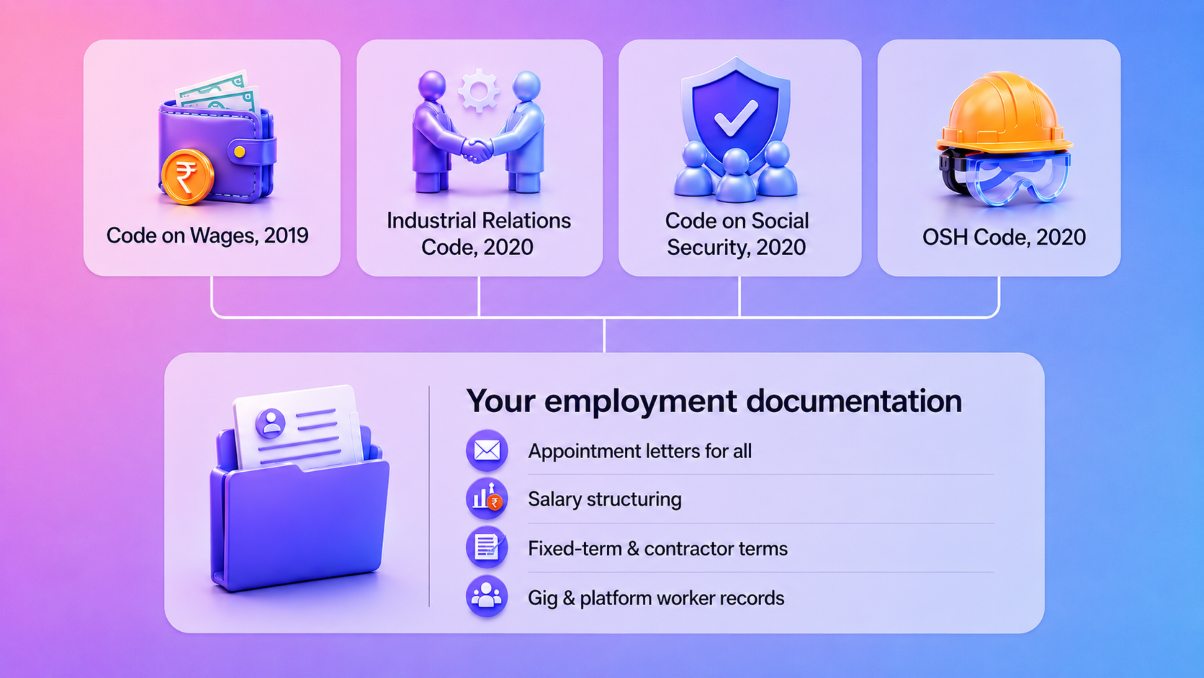
On 21 November 2025, the Government of India brought all four Labour Codes into effect: the Code on Wages 2019, the Industrial Relations Code 2020, the Code on Social Security 2020, and the Occupational Safety, Health and Working Conditions Code 2020. Together they consolidate 29 older central labour laws into a single framework, one of the most significant employment-law shifts in decades.
For employers, the headlines are about wages, gig workers, and social security. The operational reality is that the appointment letter, the employment contract, and the records behind them are exactly where these duties are written down and proven. Get the paperwork right and compliance follows. Get it wrong, or keep it informal, and the exposure shows up at audits, disputes, and exits.
Why the Labour Codes Change Your Employment Documentation in 2026
1. Appointment letters move from good practice to expectation
A central theme of the reform is that every worker should receive an appointment letter, as a matter of transparency and job security. For organizations that have historically issued formal letters to white-collar staff but handled contract, frontline, or seasonal workers informally, this is a real change in documentation volume and consistency. The appointment letter becomes a baseline record for the whole workforce, not just a subset of it.
2. The definition of wages has changed, and your contracts encode it
The Code on Wages introduces a revised statutory definition of wages that took effect on the implementation date. This definition influences how salary components are structured, because allowances and other elements are tested against the wage base, which in turn affects calculations such as provident fund, gratuity, and bonus. Salary structures live inside employment contracts and appointment letters, so the definition is not an abstract legal point. It is a drafting question for every offer you make.
3. Fixed-term and gig or platform workers need the right paperwork
The Industrial Relations Code formally recognizes fixed-term employment, and the Code on Social Security extends coverage towards gig and platform workers. Each of these brings documentation consequences: fixed-term terms and benefit parity have to be captured accurately, and engagement records for new categories of workers have to exist in a form you can produce later.
4. The rules are still being finalized, so documents will change again
While the Codes are in force, the detailed Central and State rules are still being framed and rolled out. That means employment templates will need further updates as the rules settle, and the practical guidance continues to evolve. Documentation that can be updated centrally and re-issued cleanly will handle this transition far better than scattered, manually maintained templates.
Where the Codes Touch Your Employment Lifecycle
- Onboarding and appointment letters. This is the highest-volume touchpoint, where standardized, correctly worded letters need to reach every new worker.
- Salary structuring. Offer letters and contracts must reflect the revised wage definition so that downstream calculations hold up.
- Contract labour and vendor arrangements. Engagement of contract workers, and the agreements with the contractors who supply them, are affected by the new framework and its registration and licensing approach.
- Fixed-term and category-specific engagement. Fixed-term terms, benefit parity, and coverage for gig and platform workers need to be documented accurately.
- Exit and records. Gratuity, full-and-final settlement, and dispute readiness all depend on clean, retrievable employment records.
How to Get Your Employment Contracts Labour-Code-Ready
1. Standardize your templates first
Lock down a current appointment letter, offer letter, and employment-contract template that reflect the new wage definition, fixed-term language, and category-specific terms. A single controlled set prevents teams and locations from drafting inconsistent documents.
2. Reflect the new wage definition in salary structuring
Work with your payroll and legal teams to align how salary components appear in contracts with the revised definition of wages, so that gratuity, provident fund, and bonus calculations rest on the right base.
3. Issue appointment letters at scale
Because the expectation now reaches the entire workforce, the ability to generate and send standardized letters in volume, without manual rework for each one, becomes essential rather than nice to have.
4. Execute and capture consent cleanly
Use electronic signatures, recognized under the Information Technology Act, 2000, to execute appointment letters and contracts with signer identity, intent, and a tamper-evident final record, so each document is both fast to complete and defensible.
5. Keep audit-ready, retrievable records
Store executed letters and contracts, along with their version history, in a central, permissioned repository. When an inspection, a dispute, or an exit calculation arises, the right document and its history should be retrievable as a single record.
6. Plan for the rules to change
Treat your templates as living documents. As the Central and State rules are finalized, you will need to update language and re-issue. So build a workflow that makes controlled updates straightforward.
India Guardrails for Employment Documentation in 2026
- Mind the transition. The Codes are in force, but where detailed rules are still pending, the relevant provisions of the existing labour laws continue to apply during the transition. So coordinate changes with your legal advisers rather than assuming every provision is fully operational.
- Watch state-level variation. Labour is a concurrent subject. State rules will differ, and multi-state employers should expect to manage variation in their documentation.
- Keep execution legally sound. Electronic execution of appointment letters and contracts is practical under the IT Act, 2000 when identity, intent, and record integrity are preserved.
- Treat this as ongoing, not one-time. The Ministry has continued to issue clarifications, so build documentation that you can revise as guidance matures.
Disclaimer: This blog is general information and not legal advice. Confirm specifics with qualified employment counsel before updating your contracts.
Conclusion
Summing up, the Labour Codes turn employment compliance into a documentation discipline. Appointment letters reach the whole workforce, the new wage definition has to be written into salary structures, fixed-term and gig engagements need accurate records, and all of it will be revised again as the rules settle.
The employers who handle this well will not treat it as a one-off template edit. They will run employment documentation as a managed system: standardized templates, salary structures aligned to the new definition, appointment letters issued at scale, clean electronic execution, and audit-ready records that can be updated as the rules evolve.
Done this way, the reform becomes manageable instead of overwhelming, because your paperwork keeps pace with the law.
Explore audit-ready employment documentation workflows with Doqfy today!
Sources and References
- Ministry of Labour and Employment, press release on implementation of the four Labour Codes, 21 November 2025 (Press Information Bureau, Government of India): https://www.pib.gov.in
- Government of India implements the four Labour Codes, effective 21 November 2025 (analysis): https://www.hsfkramer.com/notes/employment/2025-posts/india-labour-codes-implemented-a-landmark-reform
- Implementation of the four Labour Codes, key changes (KPMG flash alert): https://kpmg.com/xx/en/our-insights/gms-flash-alert/flash-alert-2025-267.html
- Labour Codes summary, November 2025 (JSA): https://www.jsalaw.com/corporate/labour-codes-summary-november-2025/
- New Labour Codes, employer preparation (PwC India): https://www.pwc.in/tax-knowledge-hub/new-labour-codes.html
- India's new labour codes overview (India Briefing): https://www.india-briefing.com/doing-business-guide/india/human-resources-and-payroll/india-new-labor-codes
- Ministry FAQs on the four Labour Codes, March 2026 (analysis): https://www.scconline.com/blog/post/2026/04/26/ministry-faqs-four-labour-codes-india-2026/
- The Code on Wages, 2019; the Industrial Relations Code, 2020; the Code on Social Security, 2020; and the Occupational Safety, Health and Working Conditions Code, 2020 (India Code, Government of India)
- The Information Technology Act, 2000, on legal recognition of electronic signatures and electronic records