
RBI Digital Lending Directions, 2025: Documentation and Execution Discipline for REs and LSPs
The RBI (Digital Lending) Directions, 2025 tighten documentation for Regulated Entities and LSPs: every RE-LSP relationship needs a contract, the full loan kit including the KFS must be digitally signed and auto-delivered, and DLG is capped. The goal is audit-ready loan execution.

Digital Lending Is Being Judged on Proof, Not Just Speed
Digital lending in India was built for speed. The Reserve Bank of India (Digital Lending) Directions, 2025 make it accountable for proof.
Issued in May 2025, the Directions consolidate and replace earlier frameworks - including the 2022 Guidelines on Digital Lending and the 2023 Guidelines on Default Loss Guarantee - into a single, stronger regime for Regulated Entities (REs) such as banks and NBFCs, and the Lending Service Providers (LSPs) and Digital Lending Apps (DLAs) they work with. The intent is transparency, borrower protection, and clean accountability across an ecosystem that grew faster than its documentation could keep up.
For lending teams, the change is concrete. The relationships, disclosures, and loan documents that used to live in scattered systems now have to be contractual, standardized, signed correctly, and provable on demand.
Why the 2025 Directions Are a Documentation Reset
1. Every RE-LSP relationship needs a contract behind it
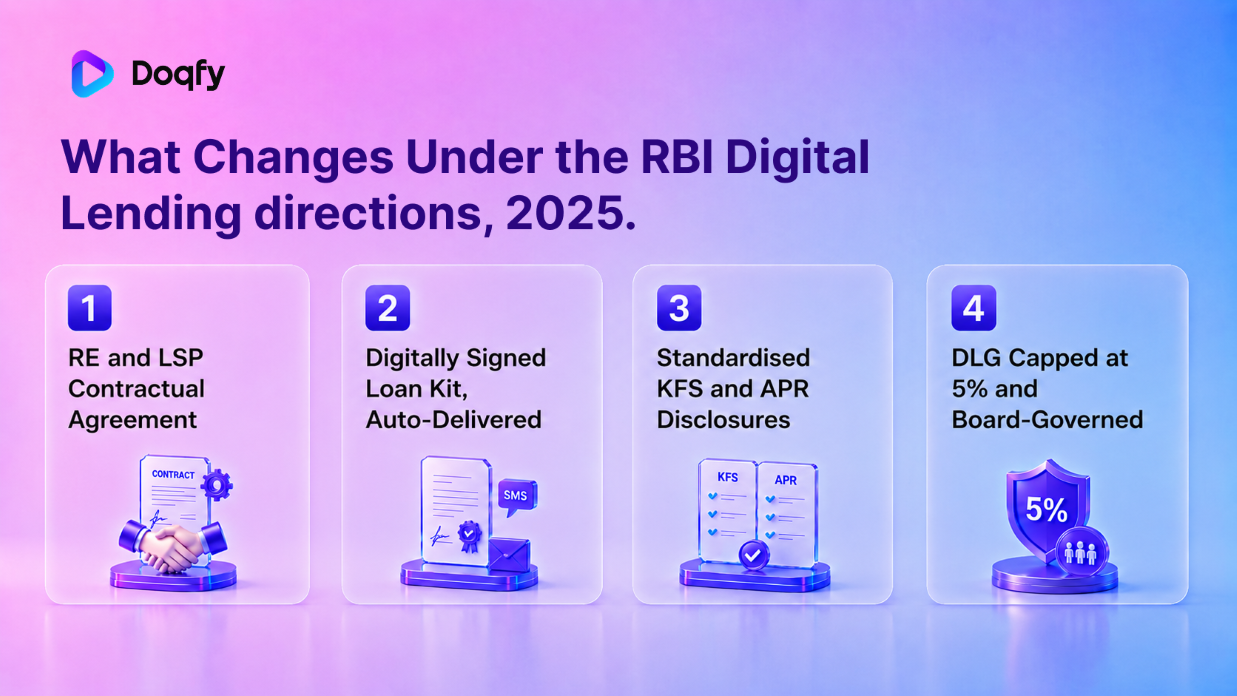
Digital lending that involves an LSP must be supported by a contractual agreement between the RE and the LSP. Outsourcing a loan journey to a partner no longer works on understanding and email - it works on a governed agreement that defines responsibilities, data handling, and grievance ownership. REs effectively have to cleanse and standardize their outsourcing contracts.
2. The loan kit must be executed and delivered the right way
The Directions reinforce that the borrower-facing documentation set - the Key Fact Statement (KFS), the sanction letter, terms and conditions, and related disclosures - should be issued on the RE's letterhead, executed using an IT Act-recognized electronic signature, and flow automatically to the borrower on a verified email or SMS after execution. The bar moves above simple click-based or one-tap acknowledgements toward identity-backed, evidenced signing.
3. Borrower disclosures have to be comparable and standardized
Where multiple lenders' offers are shown, each must clearly display the RE's name, loan amount, tenure, annual percentage rate, and repayment terms, with a link to the KFS so borrowers can compare like for like. Standardization is not a design preference here - it is a compliance requirement.
4. Default Loss Guarantee arrangements are capped and governed
DLG cover is limited to a maximum of five percent of the total disbursed amount of the specified loan portfolio, must be backed by a board-approved policy, and can only be entered into with eligible LSPs incorporated as companies. These are contractual, documented, and disclosable arrangements - not informal risk-sharing.
Where Documentation Breaks in Digital Lending
Common failure points the directions are designed to close:
- Inconsistent KFS and loan kits - different partners generating different formats, making comparability and audit difficult.
- Weak execution evidence - acknowledgements that cannot prove borrower identity, intent, or the integrity of the final signed record.
- Undocumented RE-LSP relationships - outsourced journeys without a clean contractual basis or clear grievance ownership.
- Scattered records - signed documents, disclosures, and approvals spread across systems with no single retrievable trail when a supervisor asks.
- Loosely governed DLG arrangements - risk-sharing set up without board-approved policy, eligibility checks, or proper disclosure.
When execution and evidence are designed separately, compliance becomes a reconstruction exercise after the fact.
What an Audit-Ready Digital Lending Workflow Requires
1. Standardize the documentation set before you scale
Lock down KFS, sanction letter, and terms templates so every loan - across every partner - produces the same, comparable, compliant output.
2. Make execution identity-backed and auto-delivered
Use IT Act-recognized electronic signatures for the full loan kit, capture the evidence of who signed and when, and ensure the signed set flows automatically to the borrower's verified contact.
3. Govern the RE-LSP relationship as a contract, not an arrangement
Bring outsourcing agreements under structured contract management, with defined responsibilities, version history, and clear ownership of borrower grievances and data handling.
4. Treat DLG arrangements as governed documents
Hold DLG agreements, the board-approved policy, eligibility checks, and disclosures in a controlled, retrievable form so the five-percent cap and the governance around it are demonstrable.
5. Build one retrievable trail for supervision
Keep executed documents, approvals, and disclosures in a central, permissioned repository so the right record can be produced quickly during an inspection or grievance review.
India Guardrails for Digital Lending Documentation in 2026
- Align signing to the standard the directions expect. Preserve signer identity, intent, and the integrity of the final record; electronic signatures are recognized under the IT Act, 2000, which makes compliant digital execution feasible when implemented correctly.
- Instrument everything for audit. Version history for every document, time-stamped approvals with role and rationale, and tamper-evident execution records are what turn "we followed the process" into something provable.
- Mind the phased commencement. Most provisions took effect immediately, while specific items such as reporting of DLAs to the RBI and the rules for multi-lender RE-LSP arrangements carried later effective dates - so map your remediation to the relevant timelines.
- Do not bolt compliance on after disbursal. Execution discipline has to be infrastructural. Disclosures, signing, and record-keeping designed in from the start are far cheaper than reconstructing evidence under supervisory pressure.
Conclusion
Summing up, the RBI Digital Lending Directions, 2025 shift digital lending from fast disbursals to defensible execution. The relationships behind a loan have to be contractual, the documents have to be standardized and signed correctly, the risk-sharing has to be governed, and every critical step has to be provable.
The lenders who handle this well will not treat it as a one-time clean-up. They will treat loan documentation and execution as a controlled system - standardized templates, identity-backed signing, governed RE-LSP and DLG agreements, and a single retrievable record across the lifecycle.
If your loan book is where speed, compliance, and risk meet, audit-ready execution is not an add-on. It is the difference between digital lending as a liability and digital lending as a controlled operation.
Explore audit-ready digital lending workflows with Doqfy today!
Sources
Primary / official:
- RBI (Digital Lending) Directions, 2025 - available on the RBI notifications site, rbi.org.in (dated 8 May 2025; the superseded 2022 circular noting the repeal is here: https://rbidocs.rbi.org.in/rdocs/notification/PDFs/GUIDELINESDIGITALLENDINGD5C35A71D8124A0E92AEB940A7D25BB3.PDF)
Corroborating analysis:
- Argus Partners – overview: https://www.argus-p.com/updates/updates/rbi-digital-lending-directions-2025-an-overview/
- Mondaq – regulatory reset (documents, DLG, flows): https://www.mondaq.com/india/financial-services/1632398/digital-lending-in-india-a-regulatory-reset-under-the-reserve-bank-of-india-digital-lending-directions-2025
- Mondaq – transparency & DLG 5% cap: https://www.mondaq.com/india/financial-services/1697900/rbis-digital-lending-directions-2025-enhancing-transparency-and-consumer-protection
- Lawrbit – key rules & CIMS: https://www.lawrbit.com/article/reserve-bank-of-india-digital-lending-directions-2025/
- Legal500 / Juris Corp – KFS & digitally signed documents: https://www.legal500.com/developments/thought-leadership/the-rbis-digital-lending-directions-2025-a-unified-code-for-a-fragmented-sector/
- NLUO CCL – comprehensive analysis: https://ccl.nluo.ac.in/post/regulatory-paradigm-shift-a-comprehensive-analysis-of-the-rbi-s-digitallending-directions-2025
- Upstox – borrower-facing summary: https://upstox.com/news/personal-finance/latest-updates/rbi-issues-digital-lending-directions-2025-key-points-to-know-before-applying-for-a-digital-loan/article-166444/